Ann Radcliffe (1764-1823) is best known for her gothic novels. These tend to take place in an indefinite romanticised past and an exotic foreign location. There is an innocent heroine, a dashing hero and an evil villain. There are gloomy castles with secret passages and mysterious supernatural goings-on which are eventually found to have a rational explanation.
Jane Austen satirises the infatuation with gothic novels in Northanger Abbey. She particularly mentions Radcliffe’s The Mysteries of Udolpho, as well as The Italian and (in Emma) The Romance of the Forest.
The Castles of Athlin and Dunbayne (1789) was Radcliffe’s first novel. It has something of the character of her later works but is rather more muted and considerably shorter, only one volume where Udolpho runs to four.
Frippery Edition ebooks are free to download and their content is in the public domain. They are in EPUB 3 format and are DRM-free. Users of Kindle readers should be able to transfer them using the Send-to-Kindle service. The kepub file is for Kobo readers.
Download:
| The Castles of Athlin and Dunbayne | EPUB | kepub |
Standard Ebooks have free editions of A Sicilian Romance and The Mysteries of Udolpho while Project Gutenberg has The Romance of the Forest.
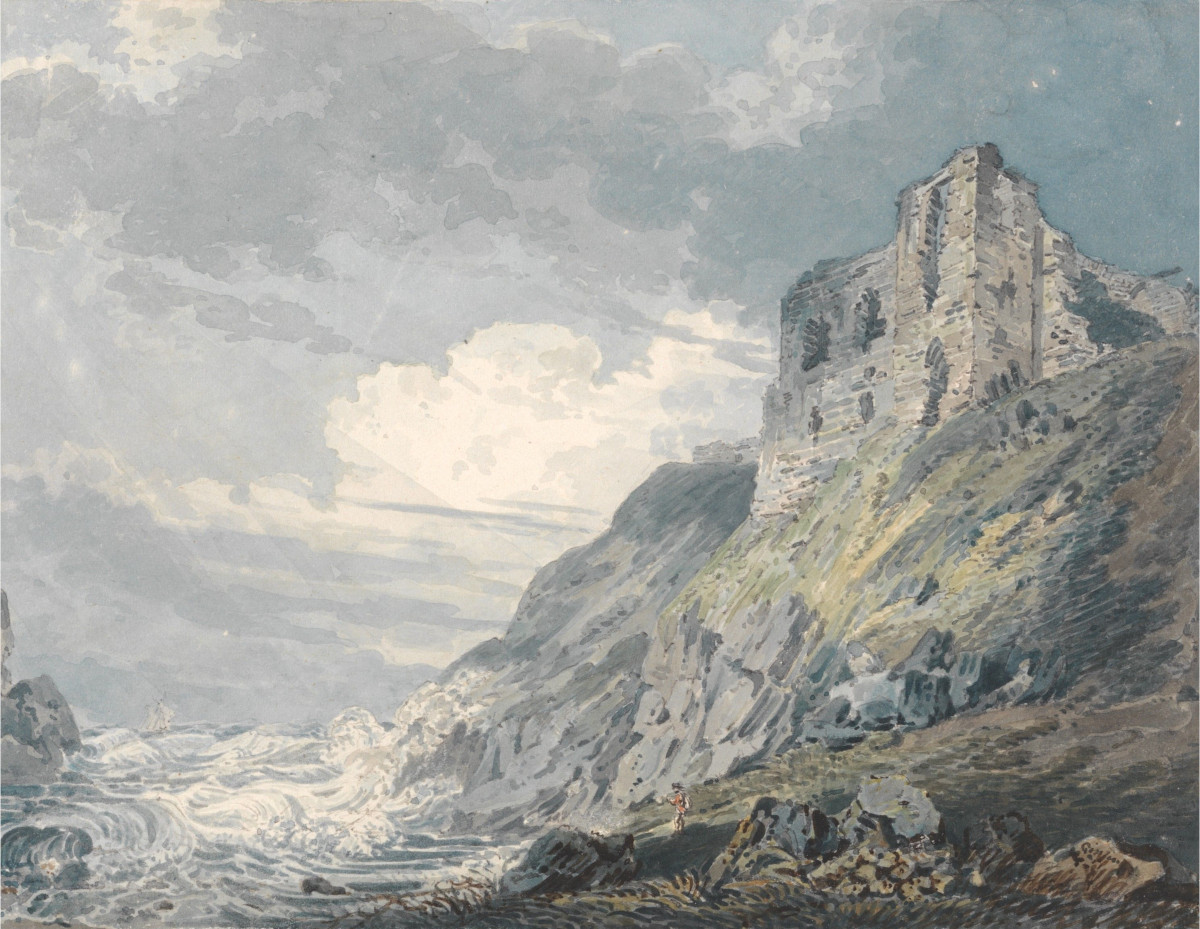
Findlater Castle, Banff, by Thomas Girtin, between 1792 and 1793. The image is from the Yale Center for British Art.
“On the north east coast of Scotland, in the most romantic part of the Highlands, stood the castle of Athlin; an edifice built on the summit of a rock whose base was in the sea.”
The Castles of Athlin and Dunbayne, Chapter I.
The aim of the Frippery Edition is to reproduce the text of the first edition of The Castles of Athlin and Dunbayne, dated 1789, with a minimum of editorial changes.
I’ve referred to the following scans of the original text:
The scans are of reasonable quality and the text is mostly accurate, but there are various errors:
The aim is to reproduce the text as originally printed. This sometimes required careful inspection to determine which character had actually been used. I may have got this wrong on occasion.
There are a few of places where I think Radcliffe could have explained things better, and a similar number where I suspect she has erred in minor details. I’ll only mention one such case.
In Chapter 6 we learn that Louisa and her daughter Laura were confined in Dunbayne Castle, where
the walls of the castle were the limits of their liberty; and that they had suffered the pressure of tyranny for fifteen years.
But in Chapter 7, only a few days later, we’re told
eighteen years had now elapsed since… the confinement of Louisa.
It’s possible I’ve missed a distinction between ‘suffering tyranny’ and ‘being confined’, but the discrepancy between fifteen and eighteen years looks like an error. If so, it wasn’t corrected in the second or third editions of the book.
We know that Laura is about twenty years old, so she’d have been two at the start of an eighteen year confinement. A plausible explanation for the figure of fifteen is that Radcliffe arrived at it by a similar calculation, but used the age of the wrong young lady: Mary of Athlin is seventeen.
However many times I proofread a book there always seem to be new issues to discover. Problems can be reported using the email link below.