Ethelinde, or the Recluse of the Lake (1789) was the second novel written by Charlotte Smith (1749-1806).
The heroine, Ethelinde Chesterville, is, of course, perfect. She is beautiful, intelligent and well educated. She nurses the sick and dying. She is ‘lovely’ and ‘an angel’. (When a surgeon has to bleed her, the blood flows from her ‘lovely arm’.) She passes much of her time in melancholy solitude. Hardly a chapter goes by without her dissolving into tears.
The hero, Charles Montgomery, is her male counterpart. He is handsome and noble minded. Due to his complicated family history, though, he has neither profession nor fortune. He is the ‘recluse of the lake’.
Naturally, Ethelinde and Montgomery are thrown together and form a romantic passion for one another. Equally naturally, difficulties arise:
Eventually, after five volumes, the situation is resolved. In my opinion:
Emmeline (Smith’s first novel) and Ethelinde are mentioned in one of Jane Austen’s early works. I have discussed this in some notes on Catharine and Ethelinde.
Frippery Edition ebooks are free to download and their content is in the public domain. They are in EPUB 3 format and are DRM-free. Users of Kindle readers should be able to transfer them using the Send-to-Kindle service. The kepub file is for Kobo readers.
Download:
| Ethelinde | EPUB | kepub |
Project Gutenberg has an ebook of Emmeline.
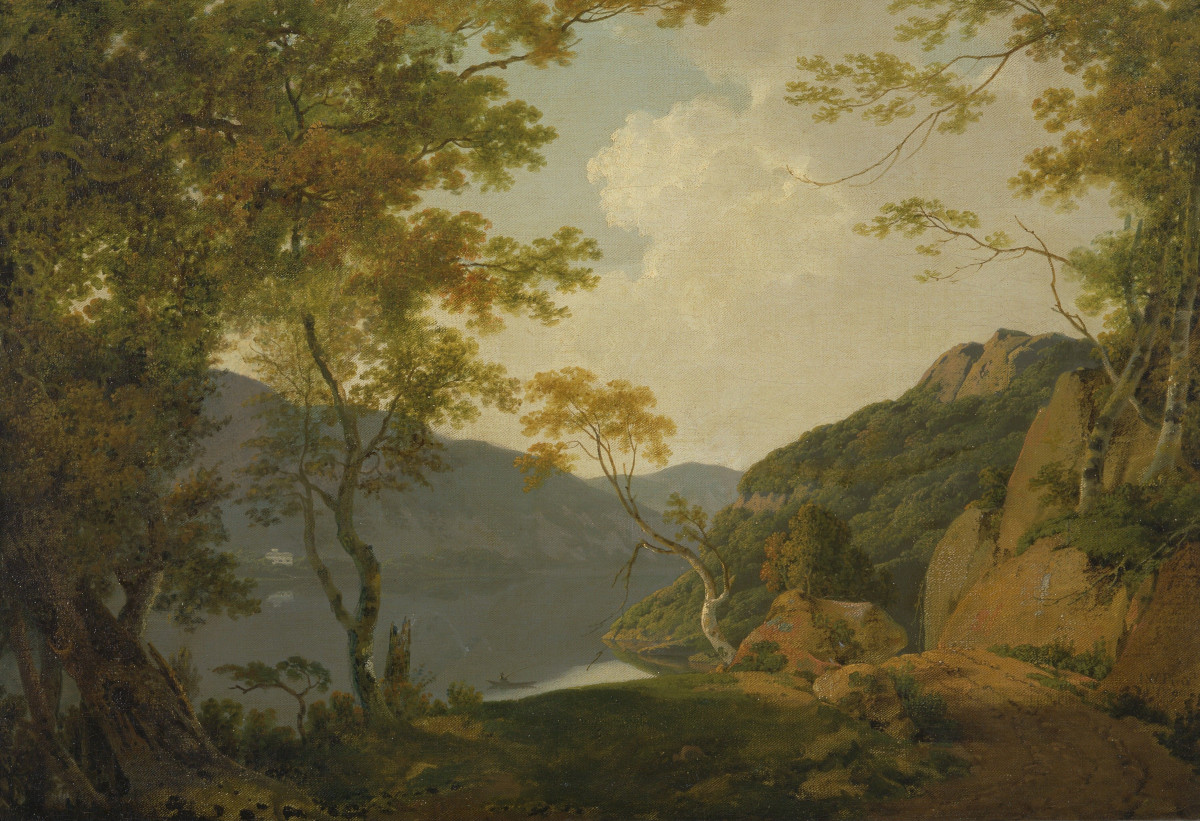
Lake Scene, by Joseph Wright of Derby, 1790. The image is from the Yale Center for British Art.
“She sat down, faint and out of breath; turned her eyes towards the white cottage, glittering on the unruffled bosom of the lake, and sighed deeply.” Ethelinde, Volume I, Chapter VIII.
The aim of the Frippery Edition is to reproduce the text of the first edition of Ethelinde, dated 1789, with a minimum of editorial changes.
Various scans of the original text are available:
| 1st Edition | 2nd Edition |
|---|---|
| Volume I | Volume I |
| Volume II | Volume II |
| Volume III | Volume III |
| Volume IV | Volume IV |
| Volume V | Volume V |
The printing and the scans are sometimes of rather poor quality.
In all cases the aim is to reproduce the text as originally printed. Sometimes this requires an informed choice to be made, often with the eye of faith. These choices may not always be correct.
A limited number of cosmetic changes have been made:
The story begins in the summer of 1784, with Ethelinde arriving at Grasmere in mid August. The timings are not very precise. A number of letters provide dates, albeit with the years obscured.
In a letter dated 17th February 1785 Miss Newenden tells her brother to expect her in London the following Tuesday, the 22nd. (Volume 3 Chapter 11) Some days after her arrival Montgomery receives a note dated 9th February. It must have been written that morning or, at the earliest, the day before. (Volume 4 Chapter 3) This is clearly inconsistent with the date of Miss Newenden’s letter.
Let’s consider the implications of the second letter being written and delivered on the 9th. Ethelinde’s departure for Brackwood on ‘the next day but one’ would take place on 11th February, at which point Miss Newenden had ‘been ten days in town’. (Volume 4 Chapter 4) After ‘near a fortnight’ at Brackwood (so around 24th) Ethelinde expects a visit from Montgomery, so she starts to watch for him from the downs despite ‘the severe winds usual towards the end of February’. (Volume 4 Chapter 7)
This suggests the date of 9th February is correct: any later and Ethelinde’s vigil could not be described as ‘towards the end of February’. It’s also consistent with the travels and letters of Mrs. Montgomery and her son during the same period. For Miss Newenden to have been in town ten days on the 11th she must have arrived on 1st February (which is indeed a Tuesday, as she indicated) and her letter would probably have been written around 27th January.
It’s left as an exercise for the reader to satisfy themselves that Colonel Chesterville died on about 11th January and that Ethelinde was therefore correct to tell her aunt on 6th April that ‘not yet three months’ had elapsed ‘since that regretted period’. (Volume 5 Chapter 4)
The incorrect date (17th February) persists in the second edition of 1790.
What follows is by no means a full glossary, just a few items I looked up for my interest and your convenience:
Barb. n.s. [contracted from Barbary.] A Barbary horse.A modern dictionary adds that the Barb is ‘similar to the Arab but less spirited’. This information is essential to understanding Miss Newenden’s raillery, which matches her character exactly and is, perhaps, the most witty thing in the book. (Volume 3 Chapter 12)
Horses brought from Barbary, are commonly of a
slender light size, and very lean, usually chosen for
stallions. Barbs, it is said, may die, but never grow
old; the vigour and mettle of barbs never cease but with
their life.
Farrier’s Dict.
Despite the care taken in the production of this edition it’s very likely some errors remain. They can be reported to me using the link below. (But remember: errors in the original are intentionally reproduced.)